Benefits of Email Marketing Tools for Business Growth
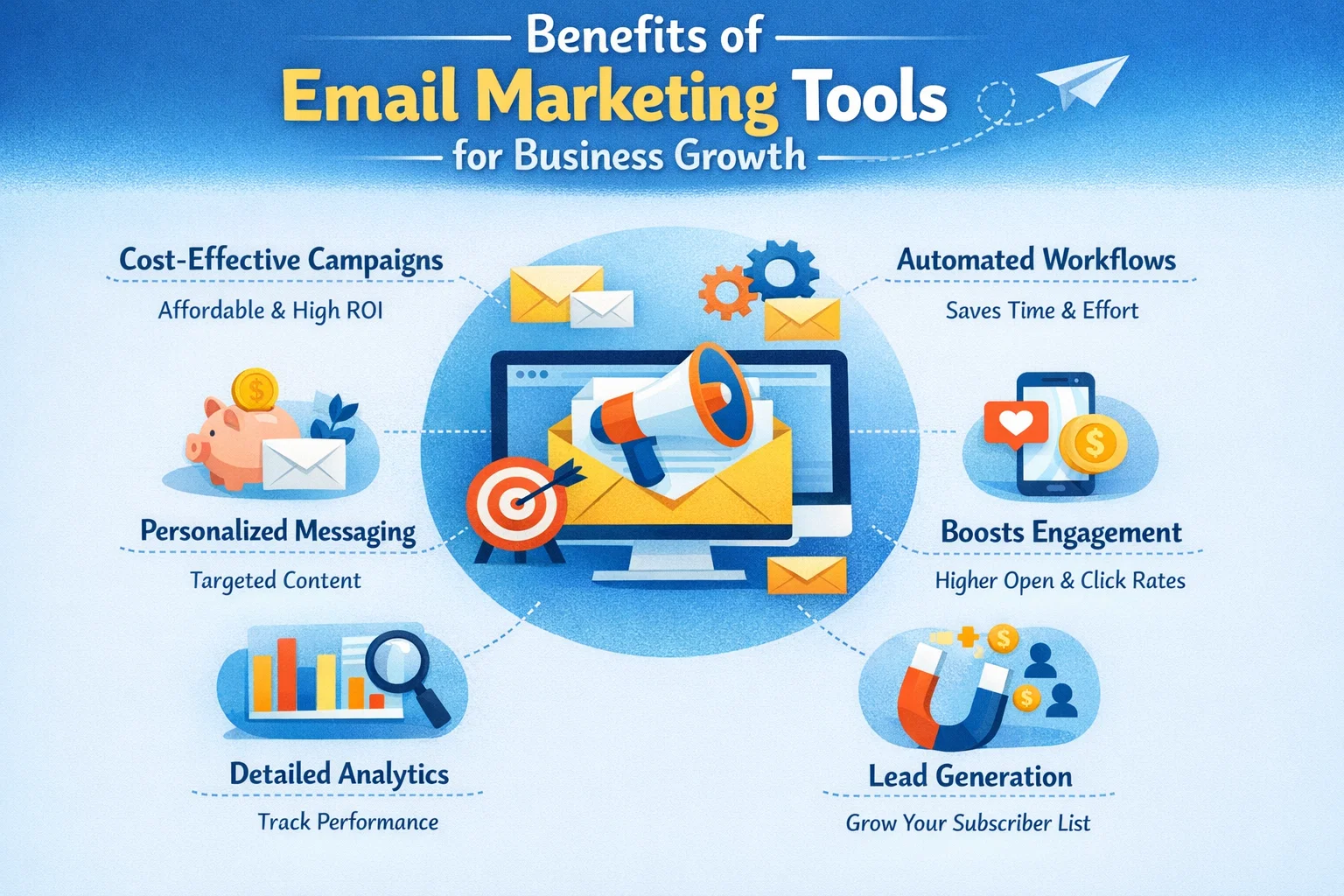
Benefits of Email Marketing Tools for Business Growth
Email marketing tools have become one of the most powerful growth engines for businesses in the digital economy. While new marketing channels continue to emerge, email marketing remains unmatched in terms of return on investment, audience ownership, and long-term customer engagement—especially for businesses operating in Tier-1 markets such as the United States, United Kingdom, Canada, Australia, and Europe.
Modern email marketing tools are no longer simple bulk email senders. They are advanced SaaS platforms that combine automation, artificial intelligence, analytics, CRM integration, and personalization to help businesses scale revenue, improve customer lifetime value, and reduce acquisition costs.
What Are Email Marketing Tools?
Email marketing tools are software platforms designed to help businesses create, manage, automate, deliver, and analyze email campaigns. These tools enable marketers to communicate directly with leads, prospects, and customers using targeted, personalized, and automated email messages.
Most email marketing tools are cloud-based and integrate seamlessly with CRM systems, e-commerce platforms, analytics tools, and customer data platforms.
Why Email Marketing Tools Are Essential for Business Growth
Business growth depends on three core factors: acquiring customers, retaining them, and increasing their lifetime value. Email marketing tools support all three pillars simultaneously, making them one of the most cost-effective growth channels available today.
- Direct access to customers without algorithm dependency
- High ROI compared to paid advertising
- Scalable automation for growing businesses
- Data-driven decision making
Key Benefits of Email Marketing Tools
1. Higher Return on Investment (ROI)
Email marketing consistently delivers one of the highest ROIs among all digital marketing channels. Businesses using advanced email marketing tools can automate campaigns, personalize messaging, and optimize delivery times—leading to higher open rates, click-through rates, and conversions.
This makes email marketing particularly attractive for advertisers and publishers targeting high-value keywords related to SaaS, finance, insurance, and enterprise software.
2. Automation That Scales Business Growth
Email marketing tools allow businesses to create automated workflows that run 24/7 without manual effort. These workflows can trigger emails based on user behavior such as signups, purchases, browsing activity, or inactivity.
Automation enables companies to nurture leads, onboard users, upsell products, and retain customers at scale.
3. Advanced Personalization
Modern email marketing tools use dynamic content, behavioral data, and AI-driven segmentation to deliver highly personalized emails. Personalized emails consistently outperform generic messages in terms of engagement and revenue generation.
Personalization includes subject lines, content blocks, product recommendations, and send-time optimization.
4. Improved Customer Retention
Customer retention is significantly more cost-effective than customer acquisition. Email marketing tools help businesses stay connected with customers through newsletters, product updates, loyalty programs, and re-engagement campaigns.
Consistent communication builds trust, strengthens brand loyalty, and increases customer lifetime value.
5. Better Lead Nurturing
Email marketing tools play a crucial role in lead nurturing. Businesses can educate prospects, address objections, and guide them through the sales funnel using automated email sequences.
This is especially valuable for B2B, SaaS, and enterprise businesses with longer sales cycles.
6. Actionable Analytics and Insights
Email marketing tools provide detailed analytics that allow businesses to measure performance in real time. Metrics such as open rates, click-through rates, conversions, revenue attribution, and customer behavior provide valuable insights for optimization.
Email Marketing Tools vs Traditional Marketing Channels
| Marketing Channel | Cost Efficiency | Scalability | Personalization | ROI Tracking |
|---|---|---|---|---|
| Email Marketing Tools | High | Excellent | Advanced | Accurate |
| Paid Advertising | Medium | Limited by budget | Moderate | Good |
| Social Media Marketing | Low to Medium | Algorithm dependent | Limited | Partial |
| Traditional Advertising | Low | Low | None | Difficult |
How Email Marketing Tools Drive Revenue Growth
- Abandoned cart recovery
- Cross-selling and upselling campaigns
- Product launch promotions
- Subscription renewals
- Transactional email monetization
Email Marketing Tools for Different Business Types
E-commerce Businesses
Email marketing tools help online stores recover lost sales, promote products, and increase repeat purchases.
SaaS Companies
SaaS businesses use email marketing tools for onboarding, feature adoption, renewals, and churn reduction.
B2B & Enterprise Organizations
B2B companies rely on email automation to nurture leads, support account-based marketing, and shorten sales cycles.
Security, Compliance, and Trust
Top-tier email marketing tools comply with global data protection regulations such as GDPR, CAN-SPAM, and CASL. Features include consent tracking, encryption, secure infrastructure, and unsubscribe management.
AI and the Future of Email Marketing Tools
Artificial intelligence is transforming email marketing by enabling predictive analytics, automated content generation, intelligent segmentation, and send-time optimization. AI-powered email marketing tools help businesses achieve higher engagement with less manual effort.
Choosing the Right Email Marketing Tool
- Automation and workflow capabilities
- CRM and SaaS integrations
- Deliverability reputation
- Scalability and pricing
- Advanced analytics
Conclusion
Email marketing tools are one of the most effective growth drivers for modern businesses. By combining automation, personalization, analytics, and AI, these platforms help companies acquire customers, retain them longer, and maximize revenue.
For businesses targeting high-value markets and competitive industries, investing in the right email marketing tools is not just a marketing decision—it is a strategic growth investment.
Comments (3)